




Japandi style
Danish cosiness meets Japanese minimalism
Japandi is an interior style that brings together the best of two worlds: Japanese minimalism and Scandinavian warmth. The results are beautiful, balanced interiors. Japandi is characterised by minimalism, natural materials and subtle contrasts.
Think functional furniture, bringing natural materials into your home and working with a limited colour palette. Just as important is balance. Avoid anything that stands out too much and create a sense of harmony throughout the space.


Scandinavian hygge
Hygge may be a term you’ve heard before, as it’s increasingly used when talking about interiors. Hygge is a Danish concept that describes a feeling of cosiness, calm and togetherness. In short: quality time in your own home. This is reflected in the soft, comfortable elements throughout the interior.
Japanese wabi sabi
What is wabi sabi? Wabi sabi is a Japanese philosophy in which beauty isn’t about perfection. Instead, natural shapes, signs of use and small imperfections give an interior its character. Think of the grain and knots in wood, handmade ceramics or an accessory that isn’t perfectly symmetrical. It allows an interior to feel lived-in and personal.


Japandi style living room
In a Japandi living room, there’s no need to fill every corner. By leaving space around your furniture, you allow individual pieces and shapes to stand out.
Start with a calm, considered layout and think carefully about what the space really needs. Leave enough room to move around and choose furniture that works together as a whole.
Begin with the largest pieces in your living room, such as the sofa and coffee table. Once you have these in place, gradually build up the interior with lighting and perhaps one distinctive accessory. This prevents the space from feeling too full and keeps the Japandi atmosphere beautifully balanced.
Extra tip: our living room step-by-step guide will help you create your living room one step at a time.
Japandi style dining room
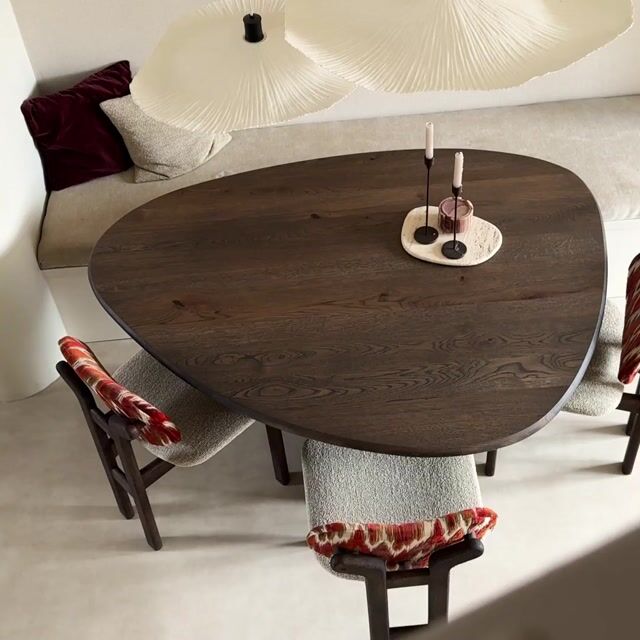
The same principles apply to a Japandi dining room. Choose a Japandi dining table as the focal point of the room. Natural materials such as oak or walnut are a perfect fit for this style.
Functionality is just as important in your dining room. A practical table base and comfortable dining chairs take care of that, bringing together a considered interior and the feeling of home.
To create balance and calm in the dining room, you can match the chair legs with the material and colour of your dining table.
Japandi furniture
Japandi isn’t just about colour and materials, the shape of your furniture also plays an important role. Clean lines are combined with soft curves and organic shapes, keeping the overall look calm without ever feeling boring.


Our Japandi furniture is also available to explore in our furniture stores. Here, you can see and compare the different options in person and discover your favourites.
Japandi furniture in our customers’ homes
What are Japandi colours?
Typical Japandi colours include beige, taupe, terracotta and dark brown. You can’t go wrong with these shades. Below, we’ve defined six colour groups to help you create your Japandi colour palette. Which colours are your favourites?
Base colours
Warm white and off-white
Tip: avoid bright white. It can feel a little too clinical and doesn’t quite fit the Japandi style.
Sand and beige
Tip: these colours work well across larger areas, such as walls, sofas or curtains.
Greige (grey-beige)
Tip: greige is a versatile colour that works with almost anything in a Japandi interior.
Accent colours
Taupe and terracotta
Tip: these are ideal colours for adding warmth to your space.
Soft green
Tip: use soft green as a subtle, calming layer rather than a bold accent.
Ink black and dark brown
Tip: 5 to 15% of the room is more than enough. Think picture frames, furniture frames and lighting.
And always keep the 60-30-10 colour rule in mind: 60% base colours, 30% supporting colours and 10% contrast. You can see how this works in the infographic below.
Japandi materials
A wide variety of materials work well in a Japandi interior. Ideally, choose materials with a natural appearance and tactile texture. Think wood, ceramic, linen or linen-look fabrics, and woven textiles.
Take oak, for example. For us, it’s the ideal material for a Japandi dining table. It feels warm, calm and timeless. Quality comes first, but oak also lends itself beautifully to distinctive designs. Think of an oak dining table with a unique base.
Ceramic also works beautifully with Japandi. The material has a natural, stone-like appearance, while subtle veining adds character. These small variations complement the sense of imperfection found throughout the Japandi style.
Finally, linen, woven fabrics and cotton are ideal choices for your sofa or dining chairs, bringing another natural element into the space. You can also match the fabric and/or colour of your seating to create a sense of unity throughout your interior.


Take a look inside a Japandi interior
Discover Maudi’s Japandi interior. A calm foundation with a colourful twist. Curious to see her full interior?
Popular interior styles
Read more

Interior styles
Hotel chic
Read more

Interior styles
Scandinavian
Read more

Interior styles
Urban
Read more

Interior styles
Modern
Read more

Interior styles
Industrial
Read more

Interior styles
Country style
Read more
Interior styles
Scandinavian
Read more
Interior styles
Urban
Read more
Interior styles
Modern
Read more
Interior styles
Industrial
Read more
Interior styles
Country style
Read more
Interior styles
Hotel chic
Read more
Frequently asked questions about Japandi style
What is the difference between Japandi and Scandinavian style?
Scandinavian style is generally lighter and fresher. Scandinavian interiors often use white as a base colour, combined with pastel shades. Japandi is calmer and more understated, with a stronger focus on simplicity and a more minimalist approach.
What is the difference between Japandi and wabi sabi?
Japandi is an interior style, while wabi-sabi is more of a philosophy and a feeling: finding beauty in simplicity.
Which flooring works with a Japandi interior?
Japandi works well with flooring that brings a sense of calm and warmth to the space. Think light oak flooring, a seamless floor in warm beige or wood-effect PVC.
Is Japandi still on trend?
Yes! Japandi may have started as a trend, but it has since developed into a well-established interior style that is here to stay.
Can I use black in a Japandi interior?
Absolutely. You can use black as an accent colour in an accessory or artwork. You could also choose a black steel base for your dining table.
What is a Japandi chic interior?
Japandi remains the foundation, but is complemented by more refined elements. Think marble, handmade accessories and a little more refinement throughout the interior.
Can I see Japandi furniture in your furniture stores?
Absolutely! You’ll find a selection of Japandi furniture in all our furniture stores across the Netherlands and Belgium. Here, you can see the furniture in person and, of course, try it out for yourself. After all, comfort is just as important as design.